
Self Care and Personal Boundaries: Why Cancelling on Yourself Costs More Than You Think

I've been thinking about boundaries a lot this year. Having a few small and large encounters that required me to step back and re assess the ways in which I am honouring my own spaces, time, and ways in which people can access me, both in the clinic and in my personal life.
Hi I'm Dr Karina Smith, if we have not met before, I am a Classical Acupuncturist and Yin Yoga Educator living and working in Melbourne Australia.
There's a particular kind of tired that has nothing to do with how much sleep you have had, and it usually comes down to the energy expended when we are saying yes to things that our intuition is really saying no to; eroding your self care, one small trade at a time.
It's the tired that comes from a week where you meant to get to the gym but didn't, meant to be in bed by ten but weren't, meant to sit with your morning tea in silence but instead answered emails through it.
Nothing dramatic happened. No single day was a disaster.
But somewhere in the accumulation of small cancellations, you lost the thread back to yourself.
What Poor Boundaries Look Like Day to Day
Most of us don't consciously decide to abandon our own needs. It happens in small, reasonable-sounding moments:
A friend needs to talk right when you were about to head out for your walk.
A client asks for "just five minutes" that becomes forty.
Someone you care about seems a little off, and you stay later than you meant to, because leaving would feel unkind.
Each of these, on its own, is just being a decent, caring person. That's not the problem. The problem is what happens when this becomes the pattern rather than the exception and when the things that keep you steady are always the first thing on the chopping block, and everyone else's comfort quietly outranks your own.
Why Self Care Depends on Having Good Boundaries
We tend to talk about self-care and boundaries as if they're two separate skills. In practice, they're the same muscle.
A boundary isn't really about saying no to other people. It's about saying yes to yourself. Saying yes to your sleep, your movement, your food, your practice, your own nervous system — even when someone else's request is standing right there, perfectly reasonable, perfectly nice, waiting for you to move it up the queue.
When you don't have that boundary, self-care becomes conditional. It only happens if nothing else comes up. And something else always comes up.

The Hidden Cost of Weak Personal Boundaries
The people-pleasing version of this rarely feels like a big loss in the moment. It's not a betrayal you can point to. It's more like a slow leak.
And I can really say this with so much truth from my own experience as a recovering people pleaser (you too? I see you friend).
You stop trusting that you'll actually follow through on what you need, so you stop planning for it. You start to feel resentful in ways you can't quite explain — not at any one person, but at the shape of your life.
You show up for everyone except the version of you that needed a decent night's sleep, or a quiet morning, or a proper meal instead of something eaten standing up between tasks.
And here's the part that matters most for anyone in a caring or teaching role: you can't actually give people your best from an empty place. The generosity that comes from genuine capacity feels completely different — to you and to them — than the generosity that comes from an already-depleted one.
How Loose Boundaries Affect Your Relationships With Others
Here's the part that's easy to miss: loose boundaries don't just erode you. They eventually confuse and unsettle the people around you as well.
When you keep saying yes past the point you actually mean it, the people you're saying yes to don't get a clear read on where they actually stand.
They get access that isn't really being freely given. It's being given because you didn't feel able to say otherwise.
And that kind of access, without a clear frame around it, has a way of tipping into something neither of you intended. Someone reaches for more than was on offer, not always out of bad faith, but because nothing ever told them where the edge was.
This part os really hard!
Because the very well intentioned over-giving to be kind, supportive and helpful, really hurts when you or another person suddenly realises they have been completely over extended and sharply move the boundary line.
I've learned this one the hard way, in a professional relationship where I let things stay looser than they should have for longer than they should have. It didn't end well, and untangling it afterwards taught me that the kindest thing I can offer anyone be it a client, a student, a friend — isn't limitless availability.
It's clarity.
A clear boundary, held early and consistently, protects the other person as much as it protects you. It tells them exactly what this relationship is, so they're never left guessing, over-reaching, or hurt by a line that was never actually drawn.
Loose boundaries can look like generosity. Often they're actually a kind of vagueness that leaves everyone, including the other person, unsure of the ground they're standing on.
When the Boundary Comes Late, It Can Land as a Rupture
There's a particular kind of pain that shows up when a boundary changes suddenly rather than gradually, when someone has had a certain amount of access, time, or availability from you for a while, and then, often without much warning, that access is pulled back or redrawn much tighter.
From the other person's side, this rarely feels like a boundary. It feels like a withdrawal. A door that used to be open is now closed, and nothing in their experience prepared them for it. Because the truth is, the boundary should have been there from the start, just held more quietly and inconsistently.
When it finally shows up abruptly, it can land as rejection, punishment, or a sign that something is wrong with the relationship itself, even when that's not the intention at all.
This is part of why loosening a boundary slowly, without ever really addressing it, tends to store up more pain than it saves. The kinder path, although it takes more courage in the moment, is to adjust in smaller, named steps, and to say plainly what's changing and why, rather than let things run on unspoken until a hard line has to be drawn all at once.
A boundary introduced gradually, with some explanation, gives the other person a chance to adjust alongside you. A boundary that arrives abruptly, after a long stretch of nothing, often can't help but feel like a rupture, even when it was, in truth, long overdue.
What Does it Feel like in the Body when a Boundary Was Needed?
In Chinese Medicine we understands that there is a set of Acupuncture Channels that travel around the outside of the body.
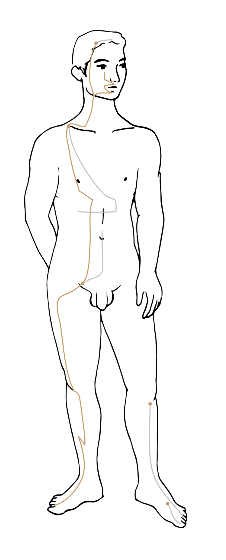
These are called the "Sinew Channels"
They run through the skeletal muscle and show up clinically when people are in pain or having difficulty with movements.
AND a very cool aspect of this channel system, is that the Sinew Channels are the interface between you and the world. And when you are not in flow with what is happening, or what you are agreeing to, these channels will tighten.
Namely the Stomach Sinew Channel will tighten, which runs up the whole front of your body, through the leg, abdomen, throat, face and head.
Have you ever said yes to something that really should have been a no and felt any of these regions tighten up?
I'm confident that you have felt this.
I also feel confident, that the next thing that happened was your mind trying to dismiss your response to the tightening and try and talk you through all the reasons that you should say yes.
Are you nodding?
Your body knows.
How to Set Healthy Boundaries: What It Actually Sounds Like
It doesn't have to be dramatic. It's rarely "no." More often it's:
"I can talk properly at 6, once I've been to the gym." "Let me get back to you tomorrow morning because I want to give this a proper answer, not a rushed one."
"I'm going to finish my practice first, then I'm all yours."
These aren't rejections. They're small acts of keeping a promise to yourself that you'd never break for anyone else.
Some Self-Inquiry: Where Is This Showing Up for You?
If any of this feels familiar, it's worth sitting with a few honest questions rather than rushing past them:
What's the one thing I keep meaning to protect, and keep letting go of first?
When I imagine saying "not right now" to the thing that usually wins, what comes up: guilt, fear of disappointing someone, a sense that I'll be seen as selfish or unreliable?
Whose voice is that, really? Is it mine, or is it someone else's expectation I've absorbed as my own?
If I look honestly at last week, how many of my own appointments with myself did I actually keep?
These aren't questions to answer perfectly. They're questions to keep asking, gently, until the pattern becomes visible enough to work with.
What to Notice in Your Body and Mood
Loose boundaries tend to announce themselves in the body before the mind catches up. As I mentioned up above, few common signs worth paying attention to:
A tightening somewhere : the jaw, the shoulders, the gut, right at the moment you're about to say yes to something you don't actually have room for.
A short fuse that seems to come from nowhere, where small things start to irritate you more than they should.
A quiet, simmering resentment toward people who haven't actually done anything wrong, they just kept asking, and you kept giving.
A sense of never quite arriving at your own life, like you're always one task away from the thing you actually needed.
None of these are character flaws. They're information. The body keeps a very accurate ledger of what's been spent and what hasn't been replenished.
Why the Trade-Off Is So Hard to See in the Moment
Here's what makes this genuinely difficult, and not just a matter of willpower: the cost of skipping your own needs is rarely immediate, while the cost of skipping the urgent thing usually is.
If there's work, admin, or an obligation that has to happen this week, the stress of not doing it shows up fast like a deadline missed, someone waiting on you, a consequence you can picture clearly.
Missing your own time at the gym, or your morning practice, or an early night, doesn't cost you anything you can point to today. So the nervous system, quite reasonably, keeps choosing the thing with the louder,
more immediate alarm.
The debt to yourself just quietly compounds instead.
I can say this honestly: in the weeks before I recently travelled to Bali to facilitate a yoga teacher training, this exact pattern won out again and again, and I went about three weeks without getting to the gym.
By the time I arrived, my body was in more pain than it had been in years, not from one thing, but from the accumulated cost of a lot of small, reasonable-sounding decisions to deal with the loud thing instead of the quiet one.
It's a good reminder that the short-term math will almost always favour the urgent task over the long-term need, unless we deliberately weight the scales back the other way.
A Few Places to Begin
You don't need to overhaul your whole life to start honouring these boundaries again. A few smaller starting points:
Treat your non-negotiables as actual appointments — written down, at a set time, the same way you'd never casually move a client's booking.
Notice the specific story you tell yourself in the moment you're about to cancel on yourself, and just name it: "I'm telling myself this is more urgent, but is it actually more important?"
Where you can, batch the recurring weekly obligations into a defined window, so they have a container instead of endless bleed into everything else.
And start with the smallest version of the thing rather than an all-or-nothing return fifteen minutes on the mat, one shorter session at the gym, ten minutes of quiet before the day takes over. The point isn't a perfect week. It's rebuilding the evidence, to yourself, that you're someone who keeps their word to you.
Frequently Asked Questions
How are self care and personal boundaries connected? Self care rarely fails on its own — it fails because a boundary wasn't held. Without a clear line around your time, sleep, movement, or rest, other people's requests will almost always take priority over your own needs, no matter how good your intentions are.
What are signs of poor personal boundaries? Common signs include physical tension (jaw, shoulders, gut), irritability that seems to come from nowhere, quiet resentment toward people who haven't done anything wrong, and a sense of never getting to the things you know you need.
Why is it so hard to prioritise self care over urgent tasks? Because the cost of an urgent task is immediate and visible, while the cost of skipping your own needs builds up quietly over time. The nervous system responds to the louder alarm, even when the quieter one matters more in the long run.
Can changing a boundary suddenly damage a relationship? Yes. A boundary that appears abruptly, after a long stretch of looser access, can feel like a rupture or rejection to the other person, even when it's overdue. Adjusting boundaries gradually and naming the change tends to protect the relationship far better than a sudden shift.
A Better Way to Measure Self Care Each Day
Instead of asking "did I get everything done today," try asking: "did I keep the appointments I made with myself?"
Not as one more thing to be perfect at, but as a genuine check-in. Because the version of you that shows up rested, fed, and grounded is not a luxury add-on to your life. It's the thing everything else is actually built on.
Did anything particular stand out to you in this blog?
Did you know you can leave a comment to let me know?
I'd love to hear how this has landed for you.
Big Love, Karina x


Comments